
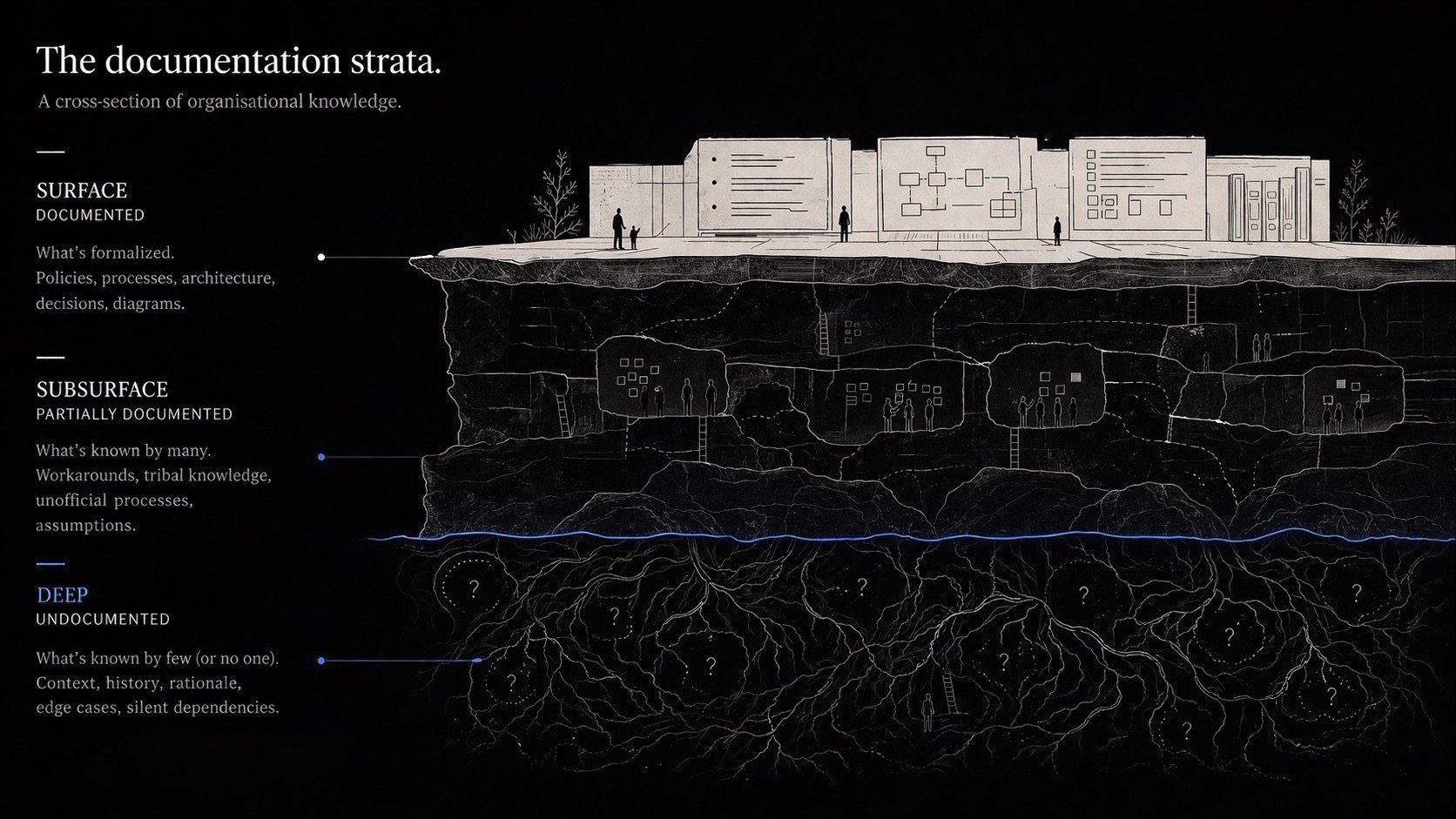
TL;DR: Every automation system needs a source of truth to operate from. If your processes live in people's heads, AI has nothing to work with. Documentation isn't bureaucracy, it's the prerequisite for every intelligent system you'll ever build. The businesses that move fastest with AI aren't the ones with the best tools. They're the ones who wrote things down first.
There's a reason most automation projects fail quietly.
Not with a dramatic crash. Not with a vendor dispute. They just... stop. The tool gets abandoned. The workflow sits half-built. The team goes back to doing it manually because that's faster than fixing the system.
The reason is almost never the technology.
The reason is that nobody wrote down how the thing actually worked.
The knowledge problem nobody talks about
When you build an intelligence layer, agents that coordinate, systems that route decisions, processes that run without human intervention, you're asking AI to act on your behalf.
But AI can only act on what it knows. And what it knows is limited to what you've given it.
The processes that live in your head? It doesn't have those. The judgment calls your senior account manager makes automatically after three years? It doesn't have those. The reason you always give client X a 10% discount but never client Y? It definitely doesn't have that.
This isn't an AI limitation. It's a knowledge architecture problem. And it exists in your business right now, regardless of whether you ever touch AI.
The question is whether you're going to surface it.
What "documentation" actually means here
Not a 40-page process manual nobody reads.
Not a Confluence wiki that's three years out of date.
Not the thing your operations manager was supposed to write in Q2 2023.
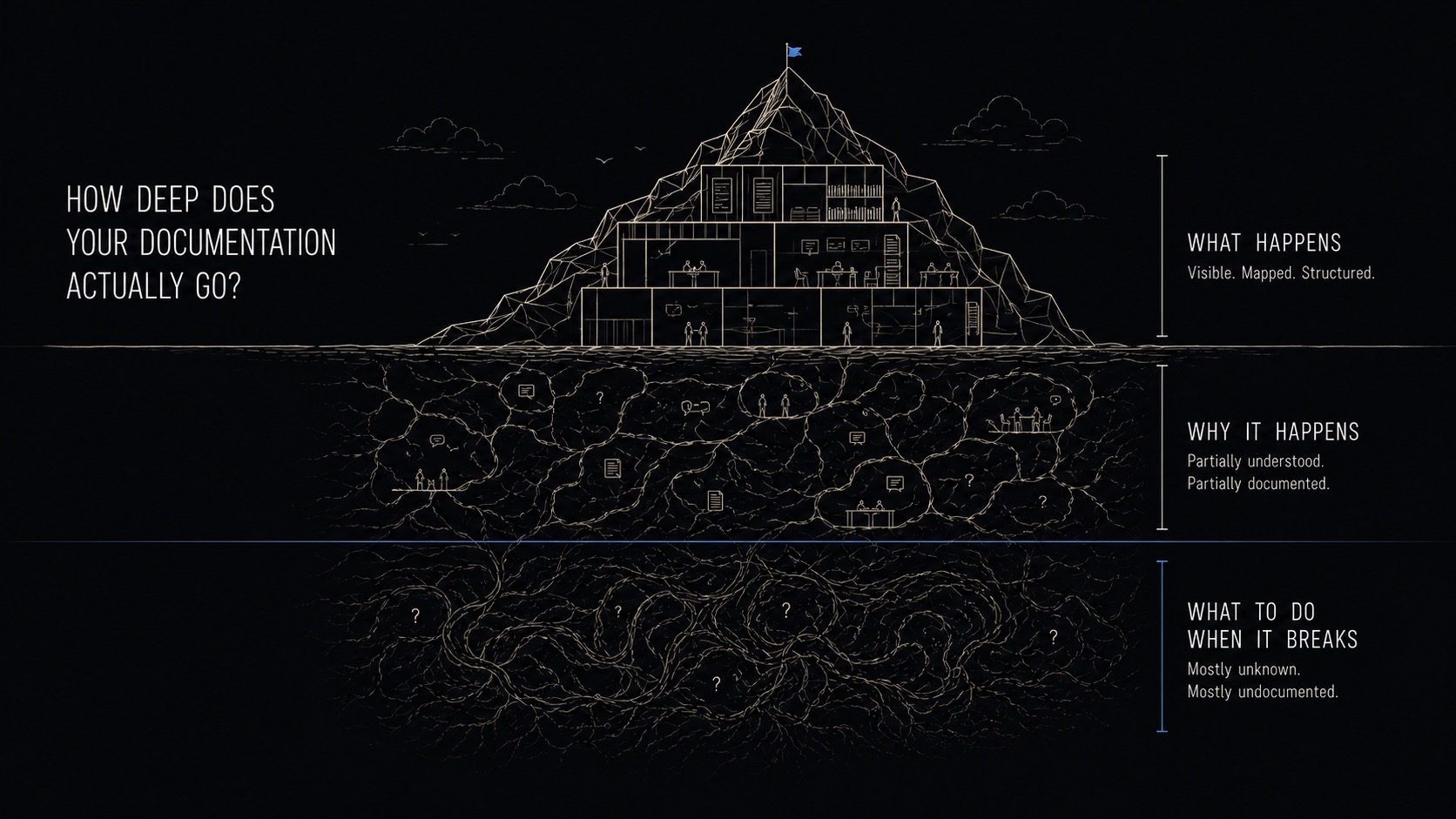
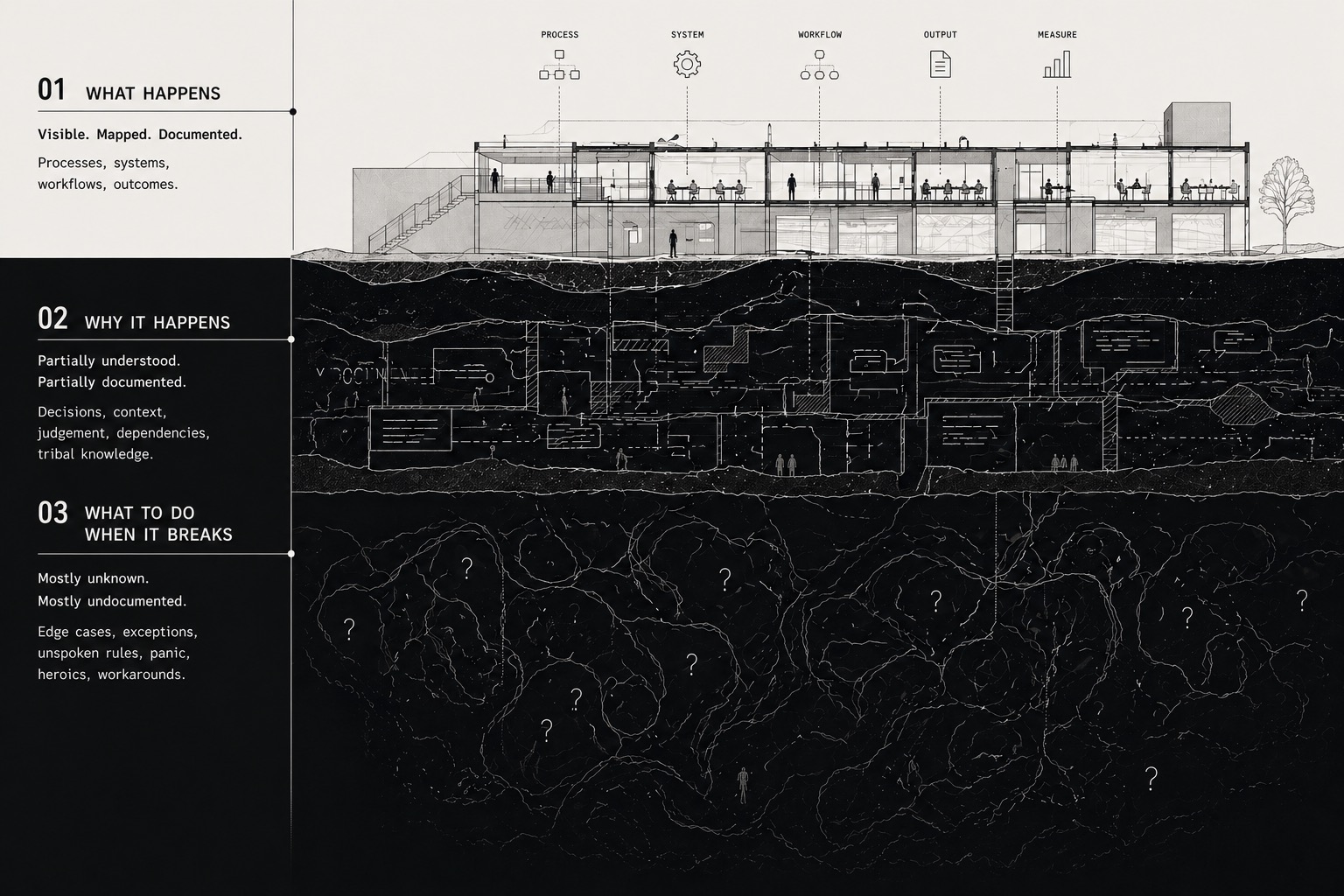
Documentation, in the context of building an intelligence layer, means capturing decisions in a form that can be acted upon by a system. It has three components:
1. What happens (the process) The sequence of steps. In what order. With what inputs. Producing what outputs. This is the part most people think of as documentation. It's table stakes.
2. Why it happens (the logic) The rules and thresholds behind the decisions. Approve invoices under £500 automatically. Escalate new clients above £50k contract value. Follow up proposals after 5 days if no response, 3 days if the client has previously gone cold. This is the part most businesses have never written down, because the human doing the job just knows.
3. What to do when it goes wrong (the exceptions) The edge cases. The things that look like category A but should be treated like category B. The situations where the normal rule doesn't apply. This is the hardest to document and the most valuable, because it's where intelligent systems earn their keep.
Most businesses have part one loosely captured somewhere. Almost none have parts two and three.
Documentation is automation because it closes the loop
Here's the frame that changes everything:
Every time you document a decision, why you made it, what the logic was, what the threshold was, you're not just recording history. You're writing an instruction that a system can follow next time.
Every time you document an exception, "we normally do X, but when Y happens, we do Z", you're training the intelligence layer to handle that exception without you.
Every time you document a process end-to-end, including the judgment calls, you're removing the requirement for a human to be present every time that process runs.
This is why the businesses that move fastest with AI aren't the ones with the biggest AI budgets. They're the ones who invested in knowing how their business actually works, and writing it down.
The documentation isn't the output. It's the infrastructure.
The compounding effect
Here's what most people don't see until they're inside it.
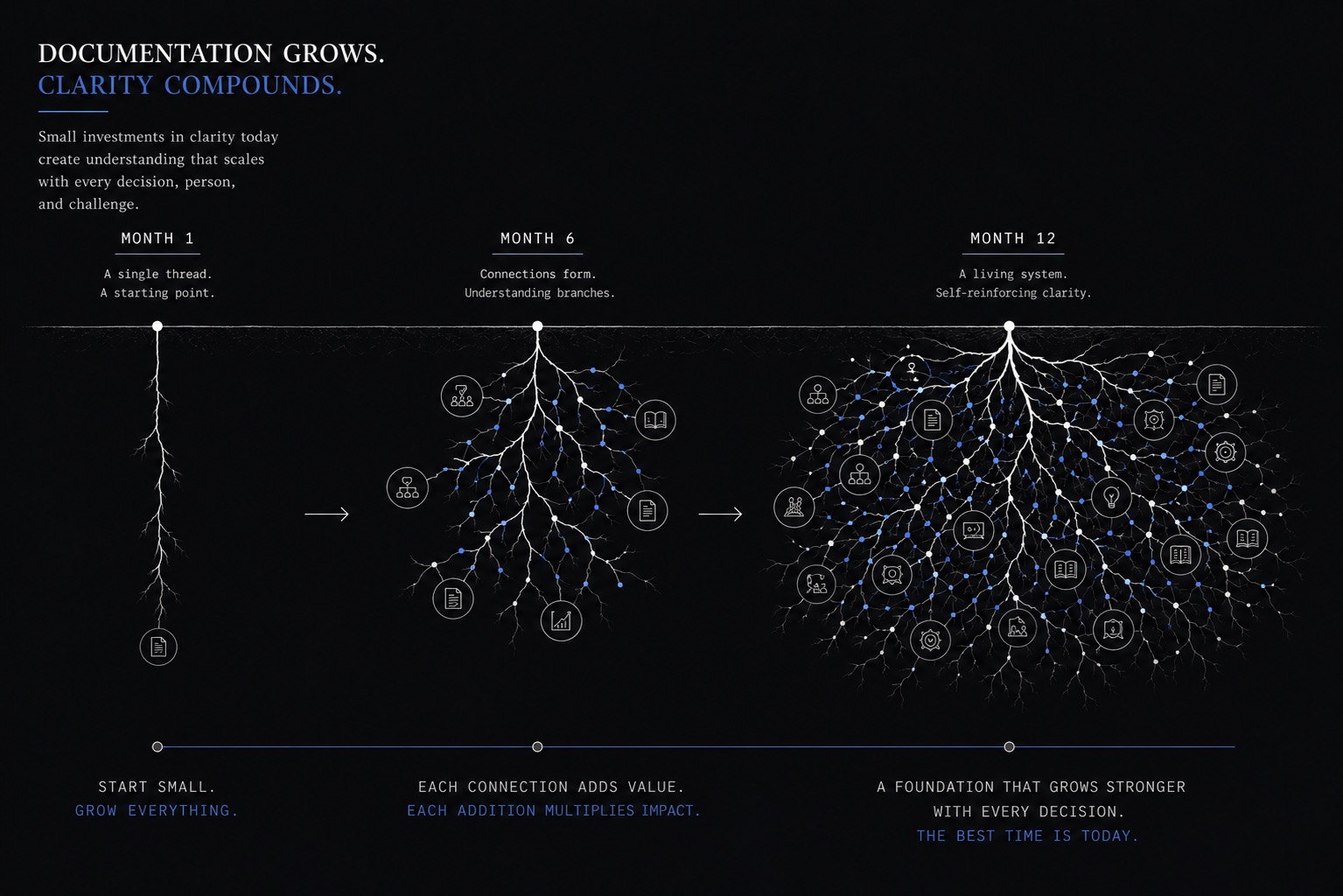
Documentation compounds.
The first time you document why a client escalation happens, it's for one scenario. But the act of documenting it forces you to think about the adjacent scenarios. You write the rule. Then you write the exceptions to the rule. Then you notice the exceptions have their own pattern.
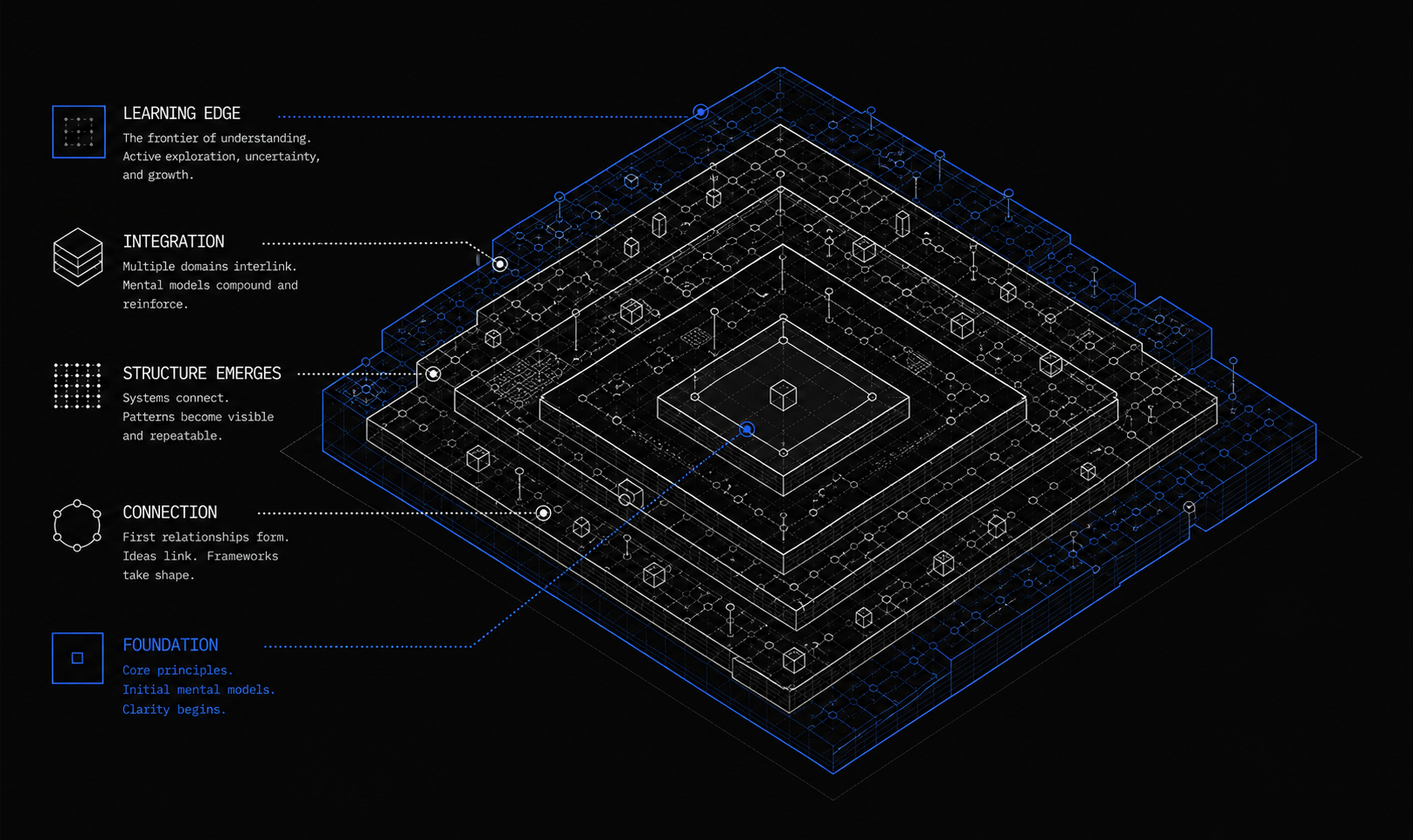
Six months later, you have an institutional model of how your business makes decisions, not because you set out to build one, but because every documentation task added a layer.
An intelligence layer built on top of this doesn't just follow rules. It improves them. Every decision it makes gets logged. Every outcome, did the client respond? was the invoice approved? did the project hit the milestone?, feeds back into the model.
Month one: the system follows your rules. Month six: the system is better at your rules than most of your team. Month twelve: the system is surfacing patterns you haven't noticed yet.
That's the moat. And it starts not with AI, but with a document.
Where to start
The most common mistake: trying to document everything at once.
Don't. Start with the decisions that happen most often and cost the most to get wrong.
Ask three questions about every process in your business:
1. How often does this happen? Daily decisions are worth documenting before monthly ones. Volume determines automation value.
2. What does a wrong answer cost? High-stakes decisions that happen frequently, follow-ups, client routing, escalation thresholds, are the documentation work with the highest ROI.
3. Who currently holds this knowledge? If the answer is "one person," document it immediately. That person will leave, be promoted, or get sick. The knowledge should not be attached to a human.
Start with those. Build from there.
The honest truth about why this doesn't happen
Most businesses don't document because documentation feels like overhead. It's not the real work. It doesn't ship. It doesn't close the deal. It sits in a folder and gathers dust.
That's true, if you're documenting for the sake of having documentation.
It's completely false if you're documenting as the first step of building a system that removes you from work you shouldn't be doing.
The frame shift: documentation isn't bureaucracy. It's the prerequisite for every intelligent system you'll ever build.
The businesses paying the coordination tax in five years will be the ones who treated documentation as a nice-to-have. The businesses that have eliminated it will be the ones who understood, somewhere around 2024 or 2025, that writing things down was the first move.
You can start today. With one process. One decision tree. One "we do it this way because."
That's how the intelligence layer begins.
Ready to map what your business actually knows, and what it needs to capture before you build? Book a scoping call. We help businesses build the documentation foundation that makes everything else possible.
Next in the series: Agents don't answer questions. They finish work.
Previous: What a business looks like when the intelligence layer is built
Stop explaining it to people
who don't get it.
Tell us what you want to build. We'll tell you if we can build it, what it costs, and when it ships — in one 30-minute call. Written build plan in your inbox within 24 hours.

How to build the intelligence layer in a business that's already running
You don't need a greenfield rebuild to install an intelligence layer. You need a starting point, a sequencing logic, and the discipline not to try to automate everything at once. This post maps the practical path.
The business that learns: how AI memory turns your operations into a moat
Most AI systems are stateless, every interaction starts fresh. The intelligence layer is different. It accumulates memory: what worked, what didn't, what each client needs, how each project type behaves. Over time, this memory becomes a compounding advantage.