The business that learns: how AI memory turns your operations into a moat

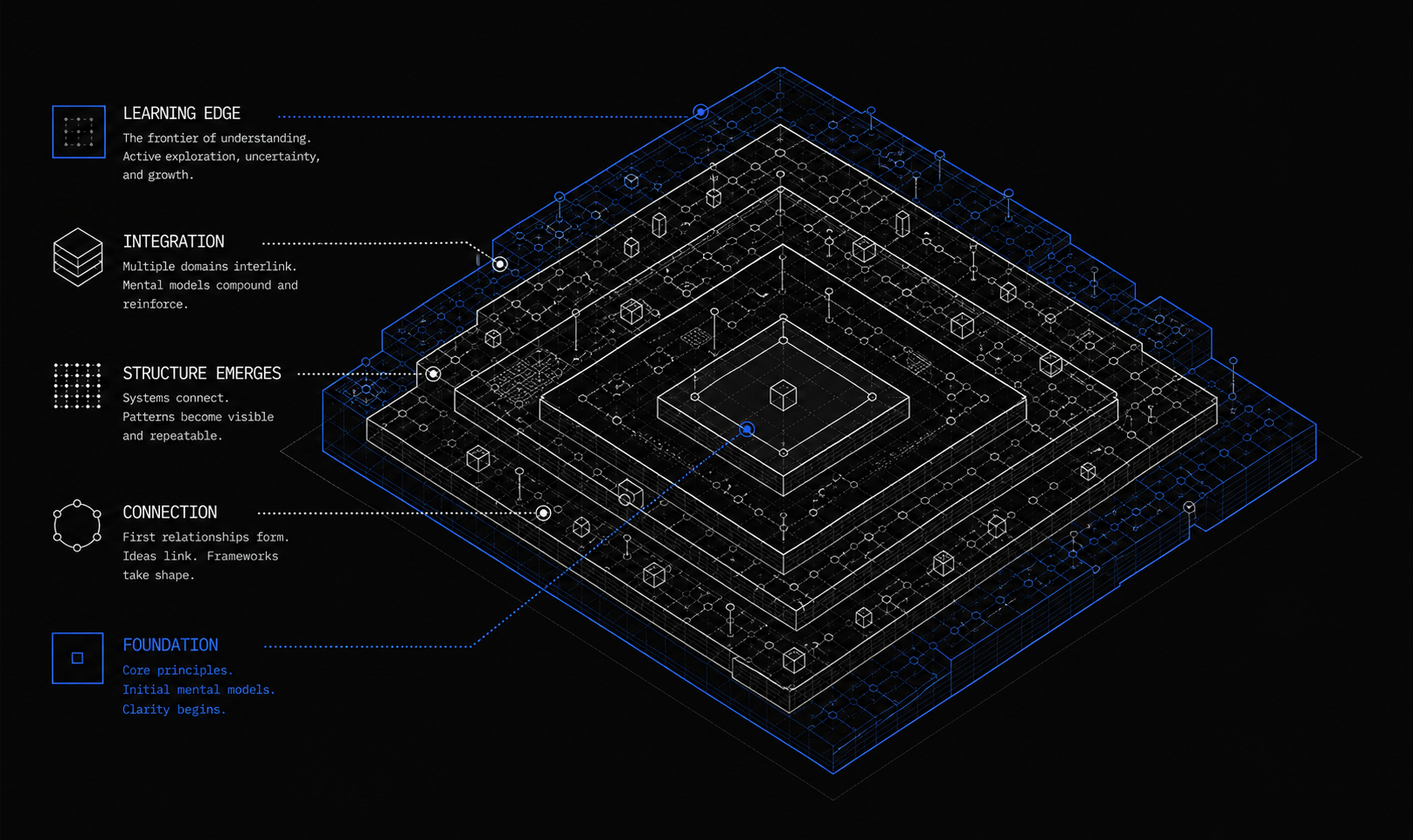
TL;DR: Most AI systems are stateless, every interaction starts fresh. The intelligence layer is different. It accumulates memory: what worked, what didn't, what each client needs, how each project type behaves. Over time, this memory becomes a compounding advantage, the business gets smarter in ways competitors can't easily copy because the learning is specific to your history, your decisions, and your clients. This post explains what that looks like and why it matters.
A senior person at your business retires, resigns, or gets headhunted.
They worked there for seven years. They knew which clients needed to be handled carefully. They knew why the pricing model works for some engagements and fails for others. They knew the supplier who always delivers late in Q4, the integration that breaks under a specific load condition, the client who always escalates to their CFO before they escalate to you.
None of that was written down.
On their last day, they had a knowledge transfer meeting. They covered the obvious things. They answered questions about current projects.
The non-obvious things, the seven years of pattern recognition and judgment, walked out the door with them.
You spent the next six months rediscovering it the hard way.
This scenario is so common it's considered normal. It shouldn't be.
The memory problem in most businesses
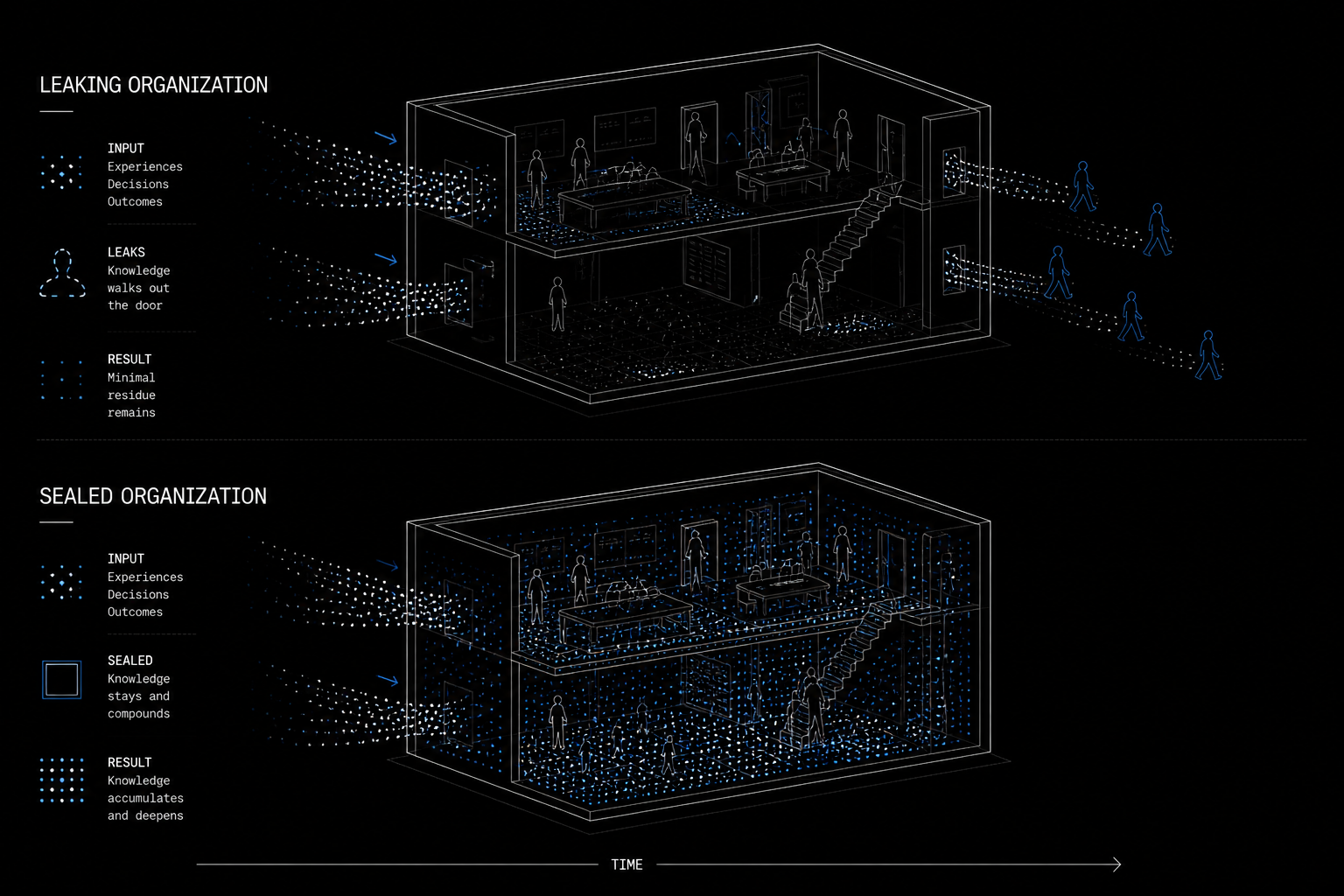
Every business accumulates knowledge. Most businesses leak it constantly.
The knowledge that accumulates: decisions made, patterns observed, relationships built, processes refined, exceptions handled.
The knowledge that leaks: all of the above, when the people who held it leave, when the systems that stored it become inaccessible, when the documentation that captured it goes out of date.
The result is a business that, operationally, never gets meaningfully smarter. It makes the same kinds of mistakes. It rediscovers the same exceptions. It re-onboards to the same clients. It re-learns the same project patterns.
The intelligence layer changes this. Not by preventing people from leaving. But by ensuring knowledge is a property of the system, not a property of the person.
What memory means in an intelligence layer
Memory in an intelligence layer isn't storage. Storage is passive, it holds things until you ask for them.
Memory is active, it shapes how the system behaves, what it notices, and what it does differently this time than last time.
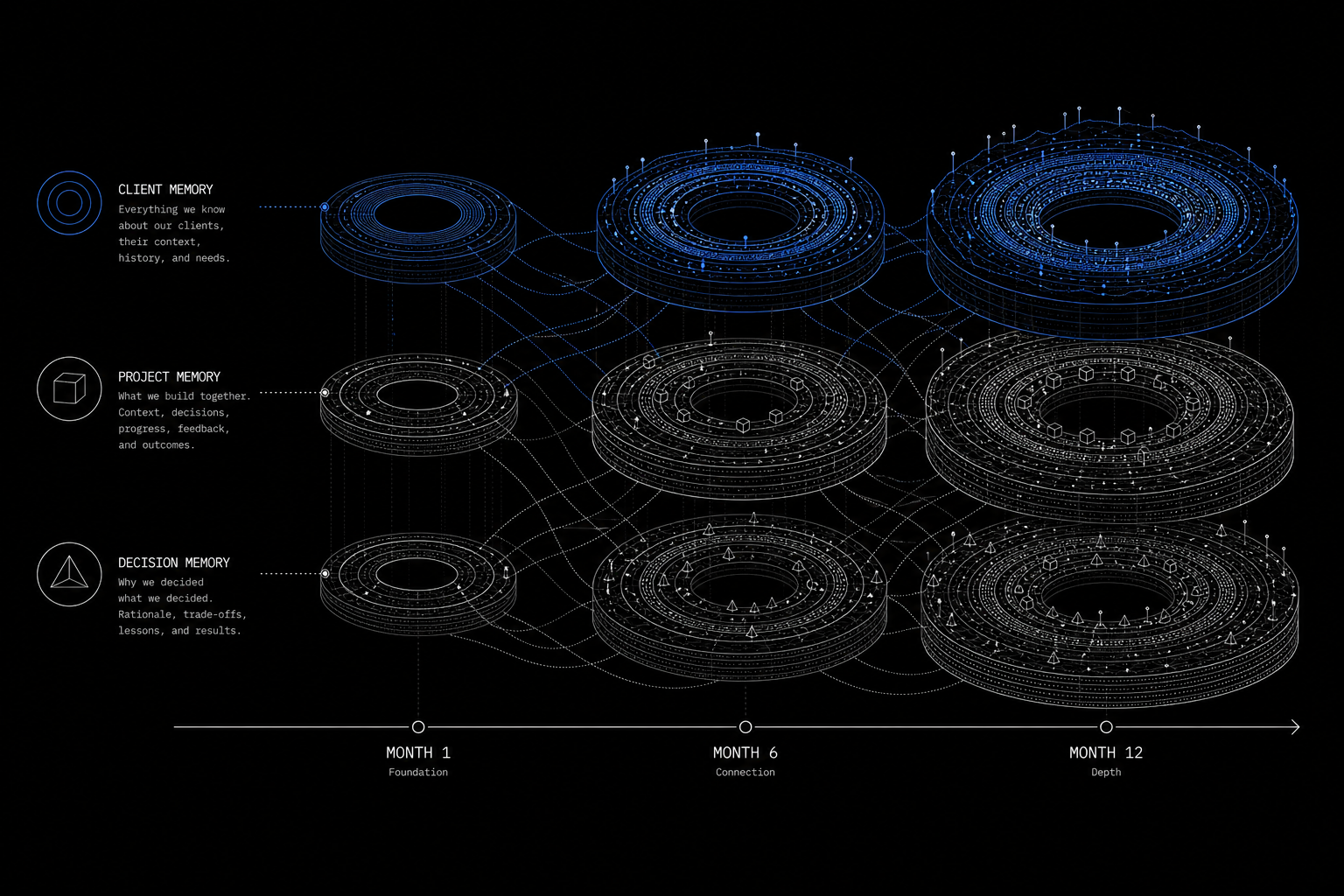
There are three kinds of memory that matter:
Client memory
Over time, the intelligence layer builds a model of each client. Not demographics and contact details, that's a CRM. A behavioural model: how they communicate, what they value, where they typically push back, what their decision-making pattern looks like, what's worked and what hasn't in past engagements.
When a new project starts with that client, the intelligence layer doesn't start from scratch. It starts with context. The agent that drafts the first communication knows the tone that lands. The system that routes the engagement knows the account manager who has the best relationship. The escalation logic knows which issues this client will escalate and which they'll absorb.
Every interaction deposits something. Every deposit makes the next interaction better.
Project memory
Every project type your business runs has a pattern. It has the places where it typically slows down, the dependencies that usually cause problems, the estimates that consistently run over. Most businesses learn this individually, each project manager carries their own version of the pattern in their head.
The intelligence layer learns it systemically. After three projects of a certain type, it starts to adjust timelines based on where slippage typically occurs. After ten, it can surface the early signals that predict which projects will run into trouble, before they do, not after.
This is the difference between experience and institutional intelligence. Experience lives in people. Institutional intelligence lives in the system.
Decision memory
Every decision the intelligence layer makes, and every decision a human makes through the system, gets logged with its reasoning and its outcome.
Did the proposal follow-up at day five work? Did the lead routing to that team member produce a conversion? Did the invoice approval at that threshold cause any issues?
Over time, the decision logic improves. Not through a programmer updating rules, through the system observing what works and adjusting accordingly. The thresholds get sharper. The routing gets more accurate. The escalation logic gets better calibrated.
Month one: you built rules based on your best current thinking. Month twelve: the rules are better than your best current thinking, because they've been tested against reality hundreds of times.
Why this is a moat
Here's the competitive strategy argument that most people miss when they think about AI.
The surface-level AI tools, the ones everyone can subscribe to, commoditise quickly. If your competitive advantage is "we use GPT-4 for our proposals," your competitor has the same advantage next week.
The intelligence layer that carries your specific memory is different. It's trained on your client relationships, your project patterns, your decision history, your exceptions. Nobody can buy that. Nobody can replicate it quickly.
The business that starts building memory now has a twelve-month head start on the business that starts next year. But it's not a twelve-month head start in tools, it's a twelve-month head start in accumulated intelligence. That gap widens, not closes, over time.
This is the moat most founders don't see building. Not a product moat. Not a talent moat. An operational intelligence moat.
What this looks like in practice
Year one: The intelligence layer is running. It's handling routine coordination, following up, routing decisions. Memory is accumulating. The system is doing what it was designed to do.
Year two: The system is meaningfully better than when it started. Client patterns are deep enough to inform how new engagements are approached. Project patterns have surfaced recurring issues that have been designed out of the process. The decision logic has been refined based on hundreds of real outcomes.
The business is running better, not because you hired better people or worked harder, but because the system is smarter.
Year three: A competitor tries to replicate what you've built. They can use the same tools. They can build the same architecture. But they can't buy your history. They start from scratch; you're running on three years of accumulated learning.
That's the moat.
The learning business vs the repeating business
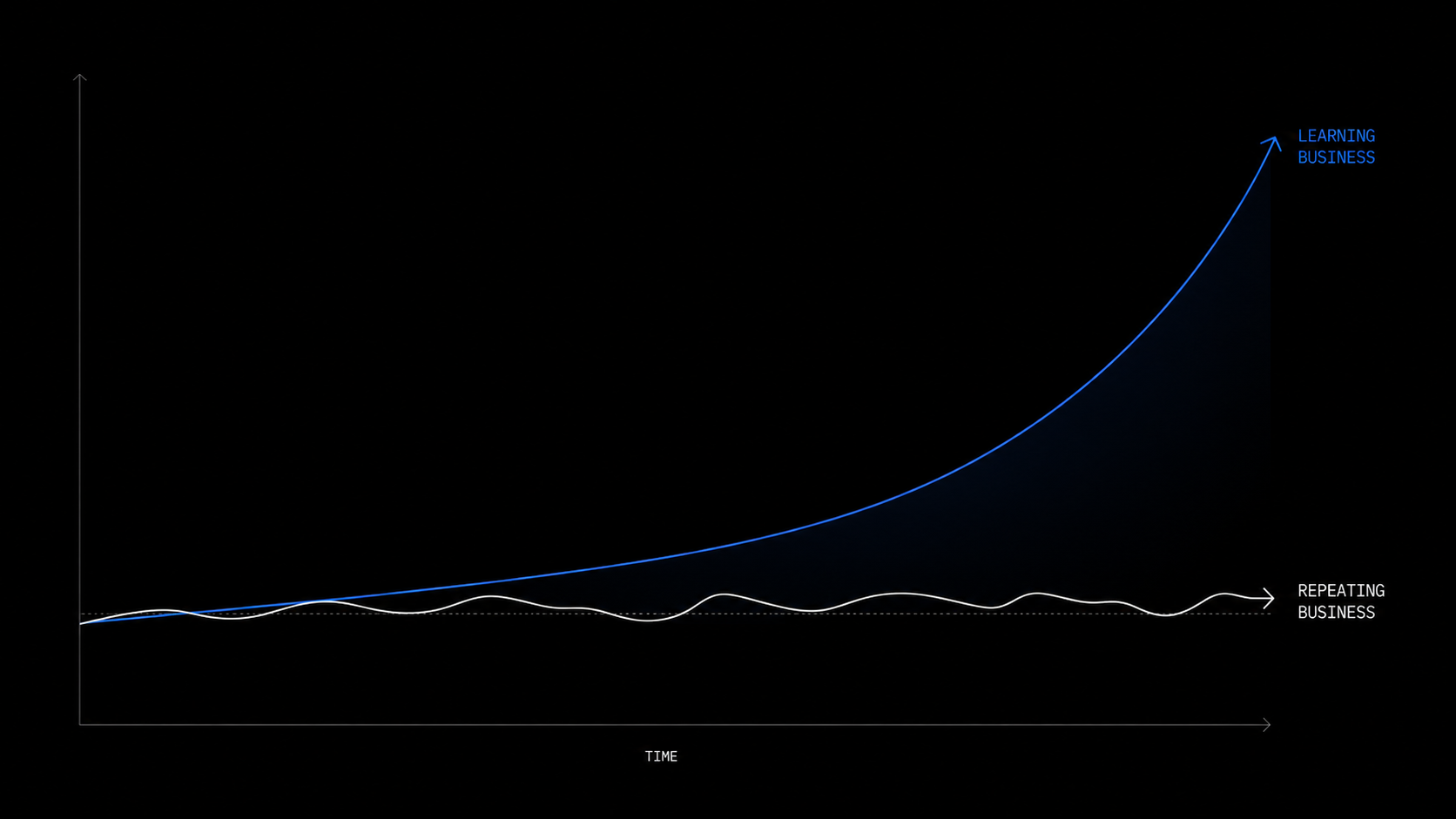
Most businesses are repeating businesses. They do the same things the same ways because that's what they've always done. When they encounter a problem, they solve it. When they encounter the same problem six months later, they solve it again.
The intelligence layer turns a repeating business into a learning business. Problems get solved once. The solution is encoded. The next time the problem arises, or the early signals that predict it appear, the system handles it.
The repeating business has a ceiling. The learning business has a compound curve.
Where memory starts
Memory doesn't start with a big AI project. It starts with the decisions you're already making.
Every time you document why a decision was made, not just what was decided, you're creating memory.
Every time an agent logs the outcome of an action, did the follow-up work? did the routing produce a conversion?, you're creating memory.
Every time a project closes with a retrospective that feeds the intelligence layer, what slipped, what worked, what we'd do differently, you're creating memory.
The businesses with the most sophisticated memory systems didn't build them in a sprint. They built them continuously, by treating every operation as an opportunity to capture something.
That's the discipline. And it starts today, with whatever process you're running right now.
Document the decision. Note the outcome. Feed the system. Watch it get smarter.
That's how a business that learns is built.
The intelligence layer we build includes memory architecture from day one, because a system without memory is just automation, not intelligence. Let's talk about building yours.
Next in the series: How to build the intelligence layer in a business that's already running
Previous: Decision intelligence
Stop explaining it to people
who don't get it.
Tell us what you want to build. We'll tell you if we can build it, what it costs, and when it ships — in one 30-minute call. Written build plan in your inbox within 24 hours.

How to build the intelligence layer in a business that's already running
You don't need a greenfield rebuild to install an intelligence layer. You need a starting point, a sequencing logic, and the discipline not to try to automate everything at once. This post maps the practical path.
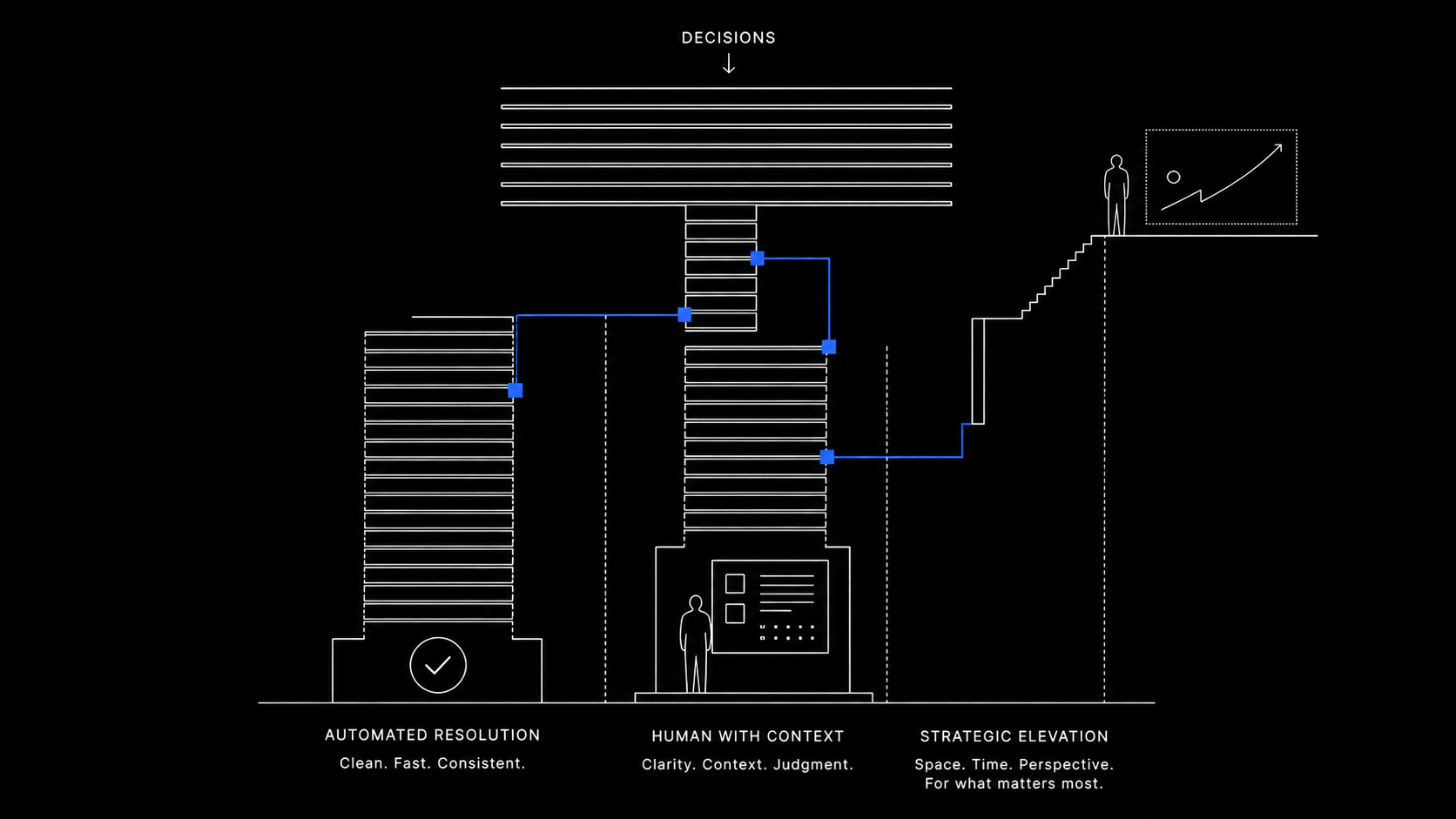
Decision intelligence: the decisions your business makes 50 times a day that should never need a human
Most businesses have hundreds of routine decisions that consume human attention every day despite being entirely precedented. Decision intelligence is the architecture that handles these automatically, routes edge cases accurately, and reserves human judgment for decisions that actually need it.