Decision intelligence: the decisions your business makes 50 times a day that should never need a human

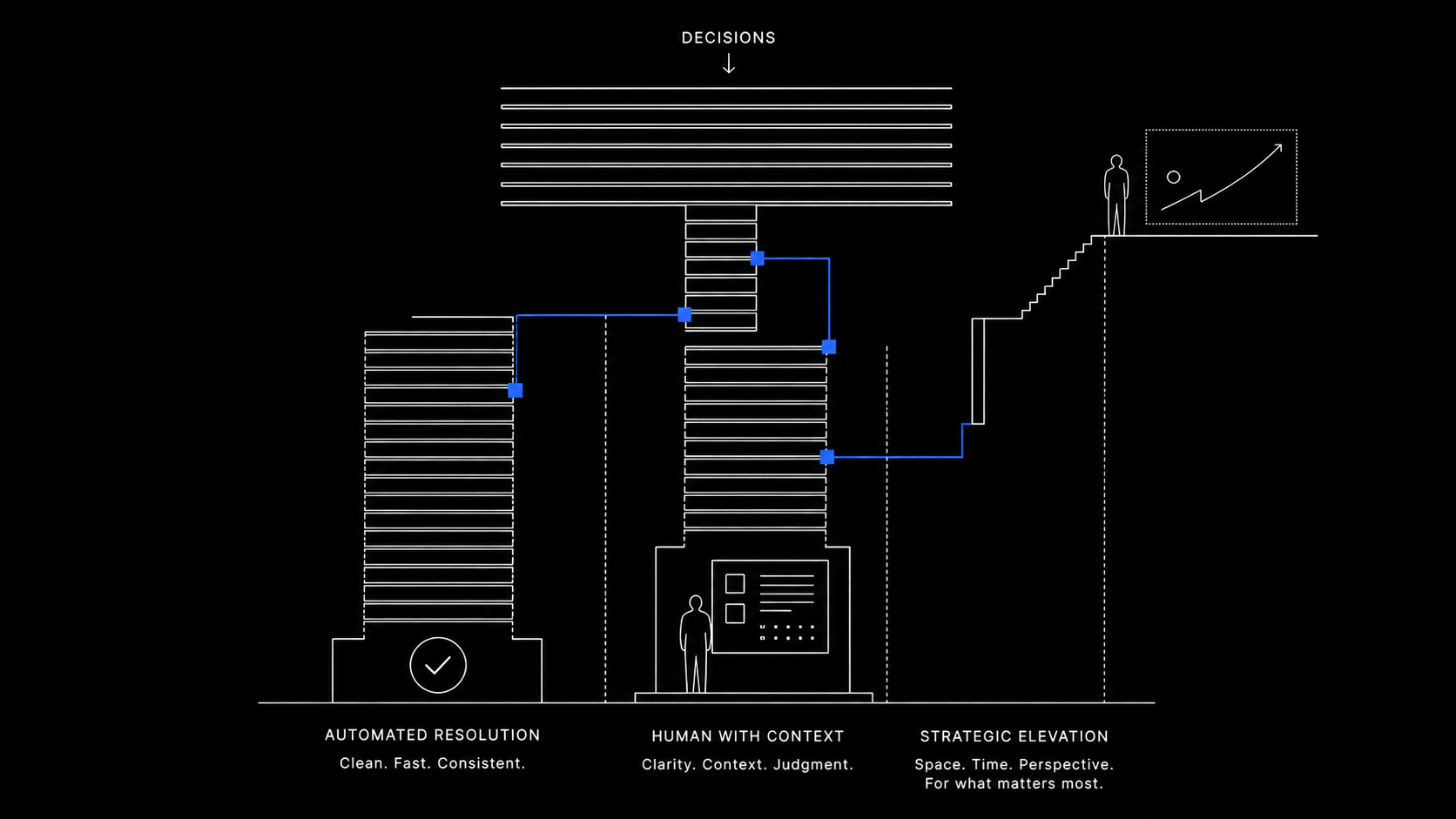
TL;DR: Most businesses have hundreds of routine decisions, qualify this lead, approve this invoice, escalate this ticket, route this request, that consume human attention every day despite being entirely precedented. Decision intelligence is the architecture that handles these automatically, routes edge cases accurately, and reserves human judgment for decisions that actually need it. The result isn't less control. It's better-placed control.
Here's a question worth sitting with.
How many decisions did you make today?
Not the strategic ones. Not the ones that shaped the direction of the business or changed how you think about a problem.
The routine ones. The approvals. The routings. The triage calls. The "yes, send it" and "no, not that client" and "route this to Sarah" and "follow up in three days."
Most founders, when they actually count, are somewhere between 30 and 80 routine decisions on an average day. Each one takes seconds to minutes. Together, they take hours.
And here's the uncomfortable part: almost none of them needed you.
The decision spectrum
Not all decisions are created equal. The intelligence layer understands this; most businesses don't.
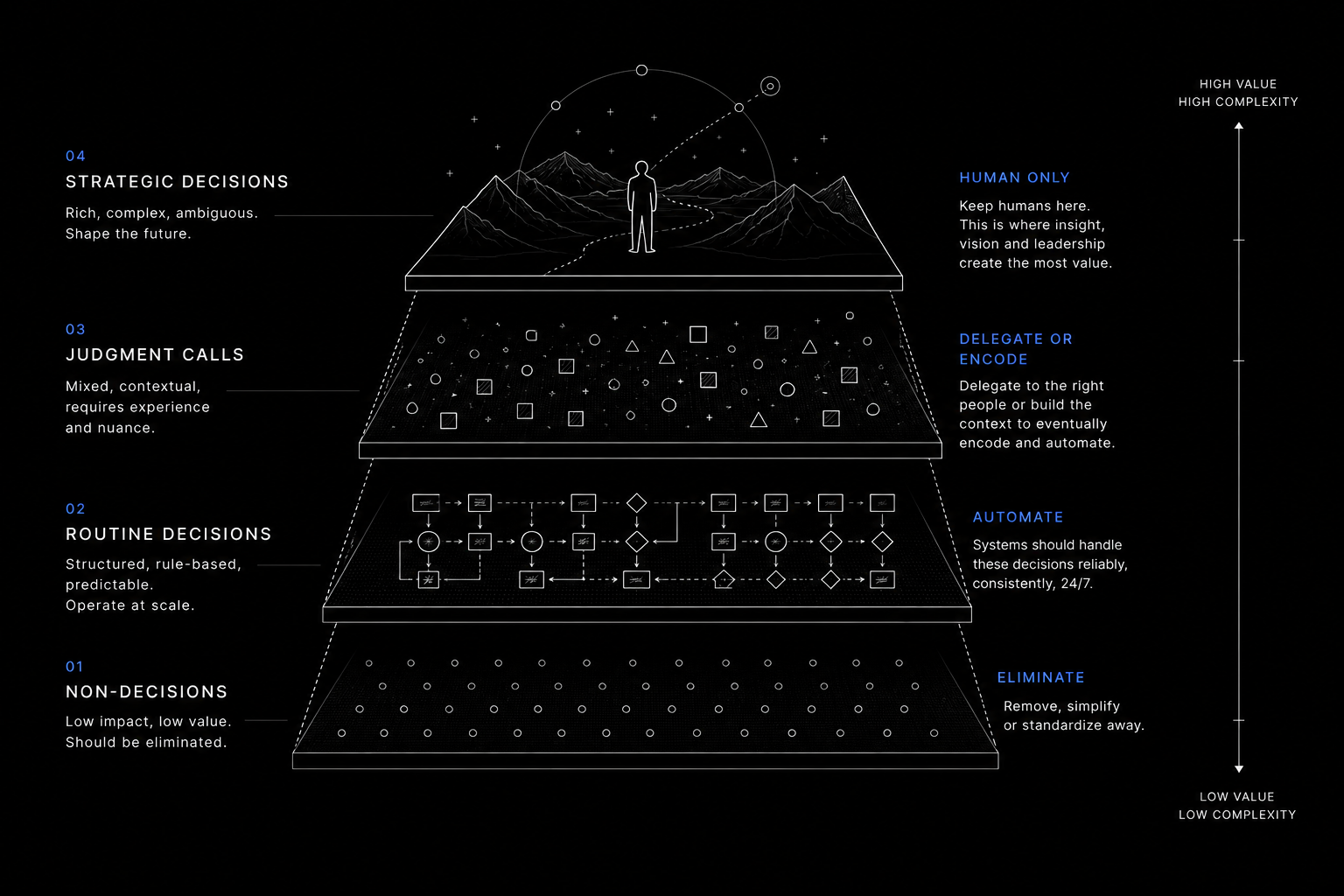
There are four types of decisions in any running business:
Strategic decisions, Genuinely novel, high consequence, require human judgment. Direction, hiring, partnerships, pricing strategy. These need you. Nothing here should be automated.
Judgment calls, Precedented but nuanced. The kind where context matters and rules are guides, not answers. A good senior person handles these confidently. They're worth delegating to the right human; eventually, they're worth encoding in the intelligence layer.
Routine decisions, Clear criteria, predictable inputs, known outcomes. Approve invoices under threshold. Route leads by geography and value. Flag support tickets by urgency category. These decisions follow rules. They should be executed by systems.
Non-decisions, Things that look like decisions but aren't. Formatting choices. Scheduling logistics. Confirmation requests for things that were already decided. These are coordination overhead dressed as judgment. They should be eliminated, not made more efficient.
Most founders spend the majority of their decision-making time on the bottom two categories. That's the problem.
What decision intelligence actually does
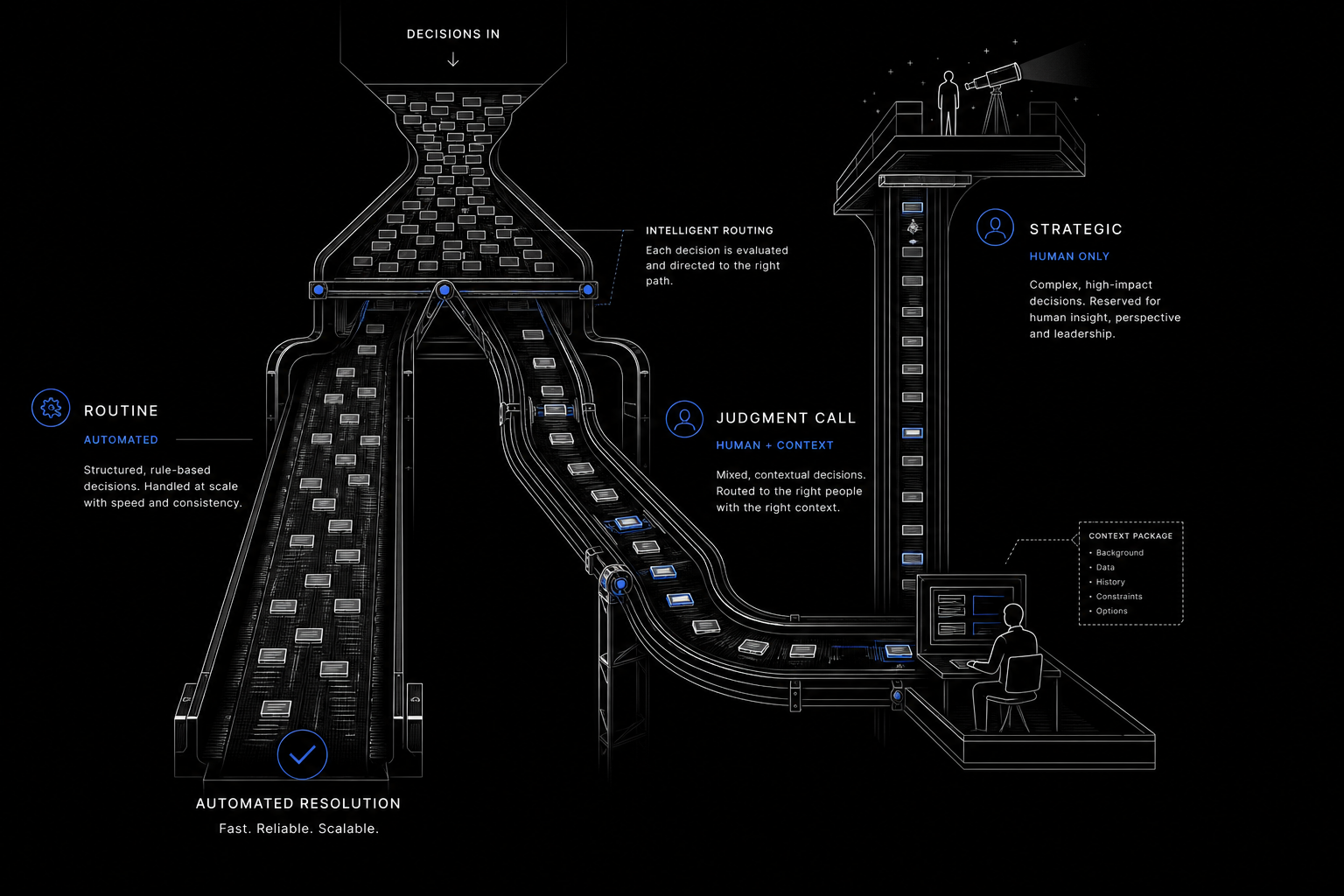
Decision intelligence is the architecture that handles routine decisions automatically, routes judgment calls to the right person with the right context, and ensures strategic decisions receive the full attention they deserve.
It has three moves:
Move 1: Automate the routine
This is the most straightforward, and the most underbuilt.
The rules already exist in your business. Your team applies them every day. They just live in people's heads, or in a shared doc nobody trusts, or in the institutional knowledge of your most senior person.
Decision intelligence starts by making those rules explicit. Then it executes them automatically.
Examples of routine decisions that should be automated:
- Invoice approvals under defined value thresholds
- Lead routing by geography, source, or company size
- Support ticket categorisation by content and urgency
- Contract renewal reminders and escalations
- Onboarding task triggers when a new client signs
- Follow-up scheduling based on pipeline stage
None of these require human judgment. All of them are currently consuming it.
Move 2: Route judgment calls with full context
The decisions that genuinely need a person are made worse by poor context. The approver who receives an invoice without knowing the project, the budget status, or the procurement history makes a slower, less accurate decision than one who receives all three.
Decision intelligence doesn't just route judgment calls, it assembles the context required to make them well. The right person receives not a question but a briefing: here is the situation, here is the relevant history, here is what similar decisions looked like, here is the recommended action with reasoning.
The human decides faster. They decide better. And their time is used for actual judgment, not for hunting down the information they need to exercise it.
Move 3: Protect strategic decisions from noise
This one is underrated.
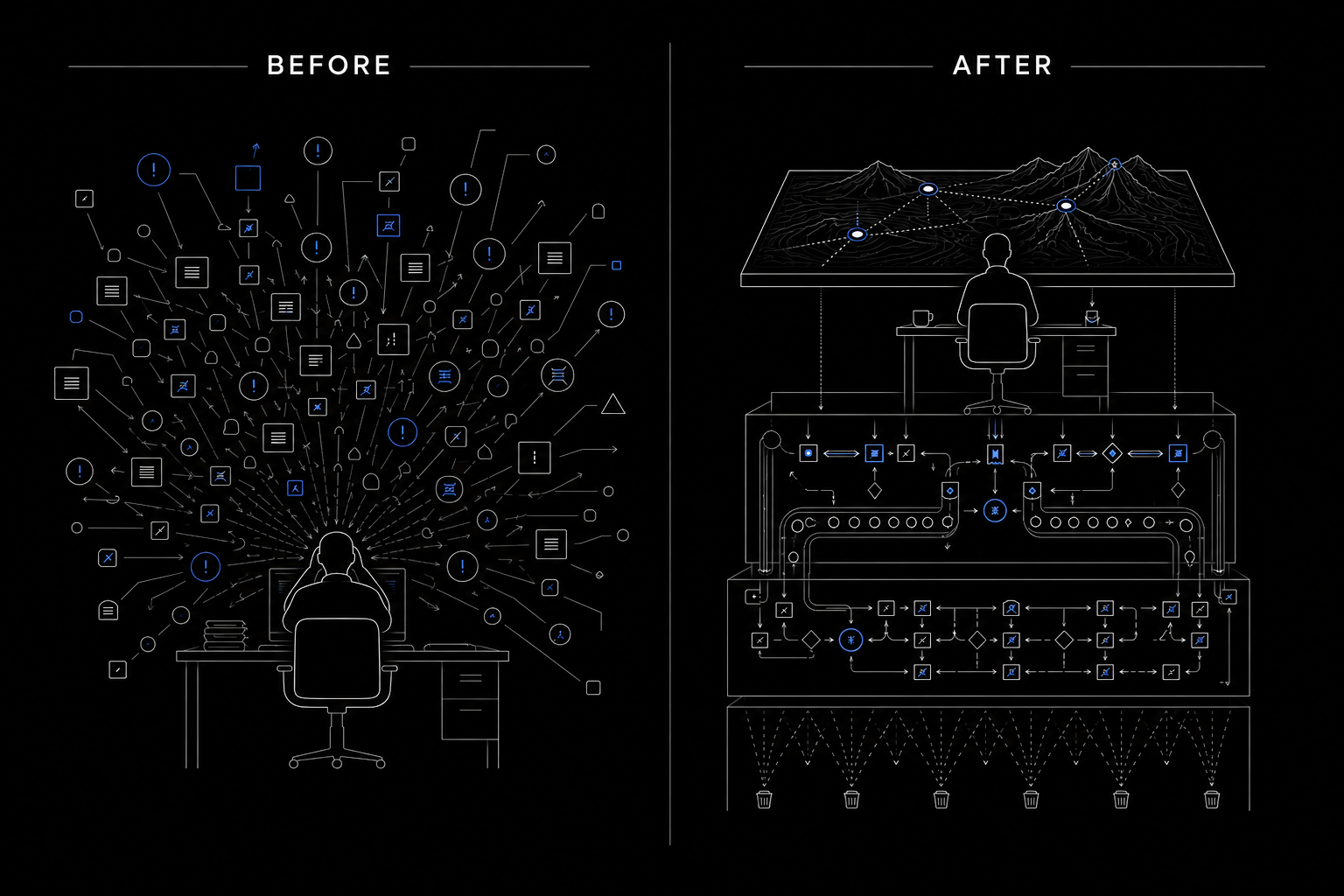
The cognitive cost of making 50 routine decisions a day isn't just the time. It's the attention. Every small decision depletes the capacity for consequential ones. Decision fatigue is real. Founders who are personally processing coordination overhead all day make worse strategic decisions in the afternoon than they would if that overhead had been handled by systems.
Decision intelligence protects strategic thinking by removing the noise. Not by making fewer decisions, by ensuring the right decisions reach the right level.
The businesses where this matters most
Decision intelligence isn't industry-specific. But it shows up differently depending on the business.
In professional services: The routine decisions are everywhere, which template for this type of contract, which fee scale for this client tier, which team member for this engagement type. They're currently handled by whoever happens to be available, inconsistently, with outcomes that vary by person. Decision intelligence makes these consistent. It also surfaces the pattern in exception cases, the clients who always need escalation, the project types that always run over.
In scaling startups: The bottleneck is usually the founding team. Every hire, every vendor, every strategic partnership, every budget change flows through two or three people who are also trying to build the product. Decision intelligence removes the routine from their queue, leaving only the decisions that genuinely need founder judgment. In practice: founders gain back 10, 15 hours a week without delegating anything that matters.
In enterprise operations: The decisions exist at scale. Thousands of support classifications. Hundreds of approval workflows. Dozens of procurement routes. Currently handled by teams whose primary skill is following the rule, not making the judgment. Decision intelligence handles the rule-following automatically, allows the team to focus on the genuine exceptions, and generates the audit trail that makes compliance demonstrable rather than just claimed.
In e-commerce and retail: Returns routing. Pricing exceptions. Inventory reorder decisions. Customer tier classifications. All rule-based. All consuming operations headcount. All automatable.
The control question
Every founder asks some version of this: "But what if the system gets it wrong?"
It's a good question. Here's the honest answer.
The system will occasionally get it wrong. So do humans. The relevant comparison isn't "AI vs perfection", it's "AI vs your current process."
Your current process has decisions made by different people with different interpretations of the same rule. It has decisions made at 5pm on a Friday by someone who's tired. It has decisions made without context by whoever was available.
Decision intelligence makes the rules explicit and applies them consistently. It logs every decision with its reasoning. It surfaces patterns in exception cases so the rules can be improved. It creates an audit trail that makes "how did we make that call?" actually answerable.
That's more control than most businesses have now, not less.
The other half of the answer: the judgment calls where humans are genuinely needed get better human attention, because the routine decisions are no longer consuming it.
Where to start
If you want to build decision intelligence into your business, the entry point is a decision audit.
For one week, log every routine decision you, or your leadership team, personally make. Note:
- What the decision was
- What information you needed to make it
- What the criteria actually were (even if informal)
- Whether the outcome was predictable before you made it
At the end of the week, count how many of those decisions had explicit criteria and predictable outcomes.
Those are your automation candidates.
Start with the highest-frequency ones. Build the rule. Test it. Refine it. Deploy it. Then move to the next.
The goal isn't to automate everything. It's to automate everything that doesn't need you, so the things that do get the version of you that isn't depleted by decisions that should have been handled by a system.
We run decision audits as part of every scoping engagement. In 30 minutes, we can identify the decisions consuming the most leadership time in your business and map the architecture that removes them from your queue. Book the call.
Stop explaining it to people
who don't get it.
Tell us what you want to build. We'll tell you if we can build it, what it costs, and when it ships — in one 30-minute call. Written build plan in your inbox within 24 hours.

How to build the intelligence layer in a business that's already running
You don't need a greenfield rebuild to install an intelligence layer. You need a starting point, a sequencing logic, and the discipline not to try to automate everything at once. This post maps the practical path.
The business that learns: how AI memory turns your operations into a moat
Most AI systems are stateless, every interaction starts fresh. The intelligence layer is different. It accumulates memory: what worked, what didn't, what each client needs, how each project type behaves. Over time, this memory becomes a compounding advantage.