
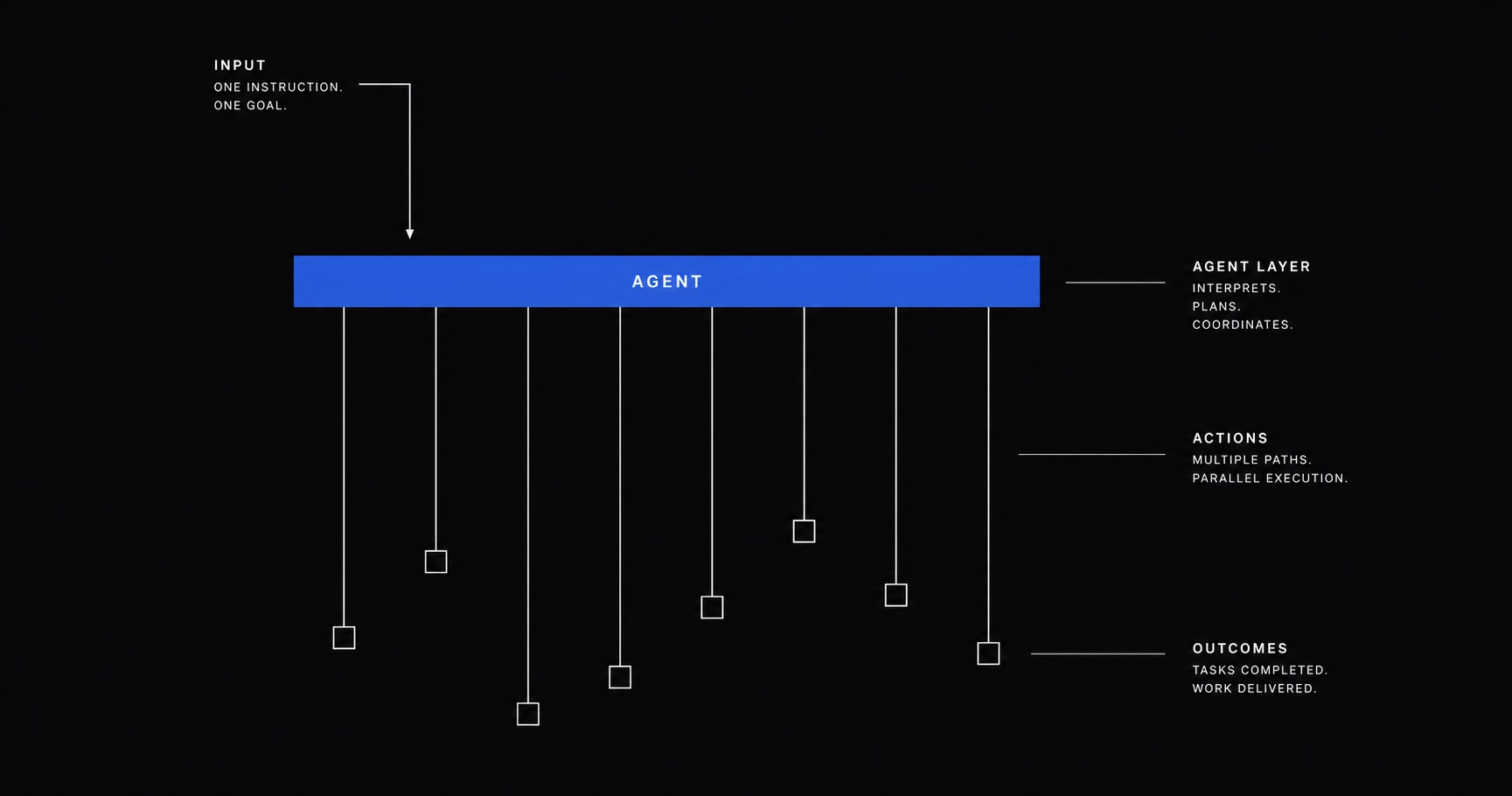
TL;DR: An AI agent isn't a smarter search box. It's a system that receives a goal, breaks it into tasks, executes them across tools and systems, handles failures, and reports back with an outcome, not an answer. The distinction changes everything about what's possible. This post maps what agents actually do, how they work in real businesses, and why they're the core of any intelligence layer worth building.
The word "agent" has been ruined by marketing.
Every chatbot is an agent now. Every AI assistant. Every tool with a text box and a submit button.
So let's clear the air before we go any further.
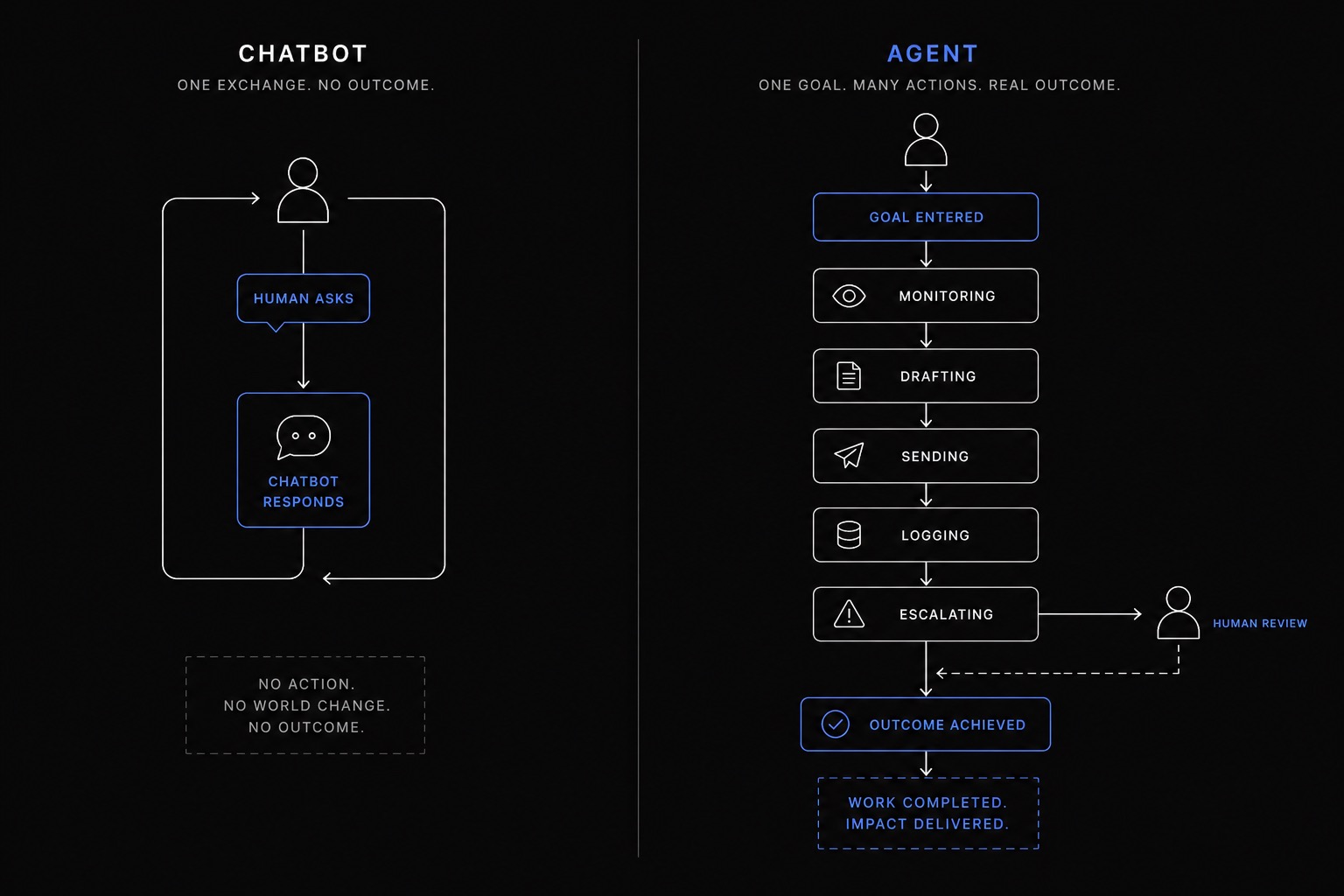
A chatbot answers questions. You ask; it responds. The loop closes when it gives you text.
An agent finishes work. You give it a goal; it acts. The loop closes when the outcome exists in the world.
That distinction is not minor. It is the entire difference between AI as a search tool and AI as a working member of your operation.
What an agent actually does
Let's make it concrete.
You want to follow up on every proposal that hasn't received a response after five days.
A chatbot helps you draft the follow-up email when you ask it to.
An agent:
- Monitors your proposal pipeline continuously
- Identifies proposals at day five with no response
- Pulls the context of the original conversation
- Drafts a follow-up in your voice, personalised to that client
- Sends it at the optimal time
- Logs the send, the open, the response
- Escalates to you only when a response requires a decision
- Updates the pipeline status automatically
You were not involved. The work finished. The outcome exists.
That's an agent.
The anatomy of an agent
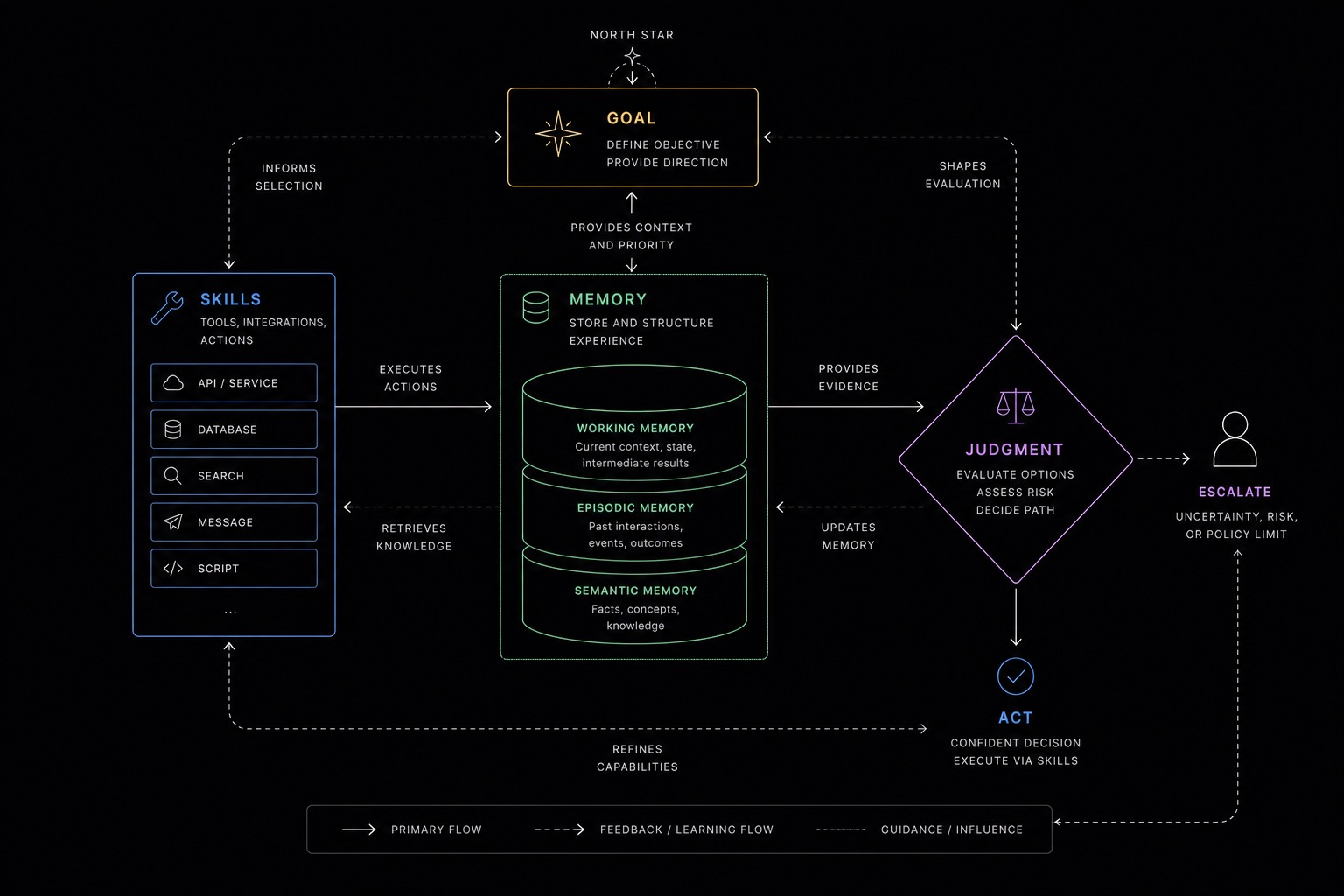
Every agent that works reliably has four components. Understanding them is the difference between agents that run and agents that break.
1. A goal, not a prompt
Agents don't respond to prompts. They pursue goals.
The goal is the instruction that persists, not "help me write a follow-up" (prompt) but "ensure every open proposal receives a follow-up at day five unless I indicate otherwise" (goal). The goal runs until it's completed or cancelled. It doesn't need you to reinitiate it.
This is why agents scale and chatbots don't. A goal runs in the background. A prompt requires you to be there.
2. Skills, the actions it can take
An agent without the ability to act is just a planner. Skills are the actions available to the agent: send an email, update a record, read a document, check a status, create a task, call an API, trigger another agent.
The richness of an agent's capabilities is determined by its skill set. A narrow agent, one with only a few skills, is reliable but limited. A broad agent, many skills, many integrations, is powerful but requires careful design.
The right architecture matches the skill set to the task. Not maximum power. Appropriate power.
3. Memory, what it knows and remembers
An agent without memory starts from scratch every time. An agent with memory builds context.
There are different kinds of memory:
- Working memory: what's relevant right now, in this task
- Episodic memory: what happened last time this situation arose
- Semantic memory: the rules, thresholds, and knowledge the business has encoded
The agent that follows up on a proposal doesn't just know it's day five. It knows the client has gone cold before. It knows the last follow-up that worked with this type of client. It adapts accordingly.
This is where the intelligence layer starts to feel less like a system and more like a colleague.
4. Judgment, when to act, when to escalate
The most important component and the hardest to design.
An agent that acts on everything is dangerous. An agent that escalates everything defeats the purpose.
Good agents have clear decision logic: here are the situations I handle autonomously, here are the situations I handle and flag, here are the situations I pause and ask. That logic is encoded by design, by the people who understand where human judgment adds irreplaceable value and where it's just friction.
The design of this logic is the intelligence layer's most critical architectural choice.
What agents look like in real businesses
Not in the abstract. In the actual operations of the kinds of businesses we build for.
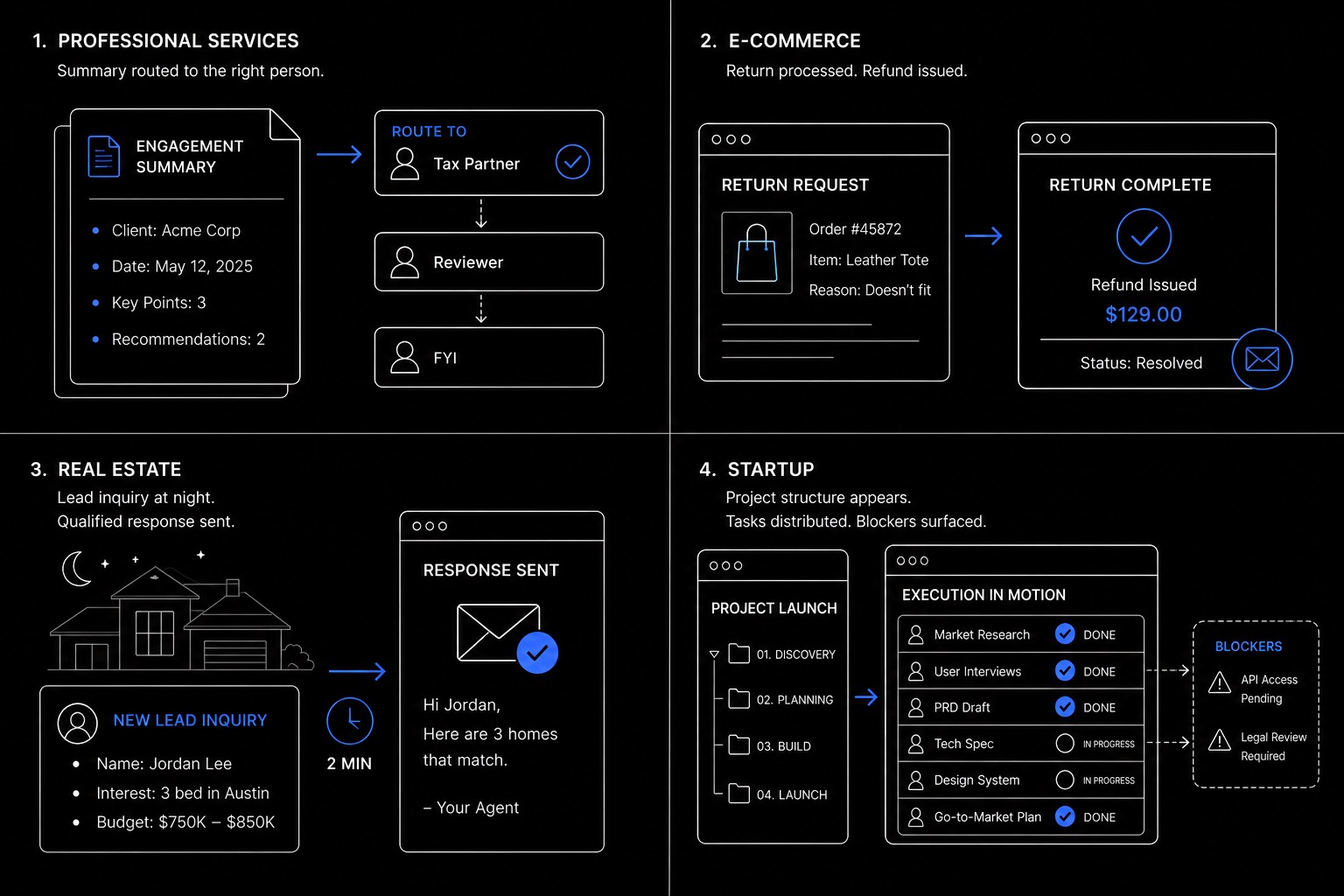
Professional services firm: A client sends a document for review. The agent ingests it, extracts key provisions, flags deviations from standard terms, generates a structured summary, and routes to the relevant team member with the three questions most likely to need a decision. The team member doesn't receive a document, they receive a briefing.
E-commerce operation: A return is requested. The agent classifies the reason, checks purchase history, applies the relevant policy (different for long-term customers, different for high-value orders), processes the return automatically where policy permits, flags for review where it doesn't, and updates inventory accordingly. A return that used to take 12 minutes of manual handling takes 0.
Real estate brokerage: A new inquiry arrives at 11pm. The agent qualifies the lead, timeline, budget, location, seriousness signals, and responds within minutes. If the lead is qualified, it schedules a call for the next business day and alerts the agent. If not, it captures the contact and sets a nurture sequence. The agent wakes up to their pipeline organised, not to a pile of unread messages.
Growing startup: Project kicks off. The agent creates the project structure, assigns initial tasks based on team availability and skill match, sets milestone reminders, monitors progress, chases blockers at 48 hours, and generates weekly status reports that nobody had to write. The project manager manages the project. They don't administrate it.
The question to ask about every repetitive process
Agents aren't the answer to every problem. They're the answer to a specific kind of problem: repetitive, multi-step work that has clear success criteria and predictable failure modes.
Before you build an agent, ask:
Can I describe the goal in one sentence? "Follow up on open proposals at day five." "Classify and process returns within policy." "Qualify inbound leads and route to the right team member." If you can't state the goal clearly, the agent will reflect that ambiguity back at you.
Do I know what 'done' looks like? Agents need a completion condition. "The proposal received a response" is a completion condition. "Do something useful with our emails" is not.
Where does human judgment actually add value? Design that point as an escalation, not a default. Everything before it can probably be automated.
If you can answer all three clearly, you have the foundation for an agent worth building.
Agents are infrastructure, not experiments
The last thing worth saying.
Most businesses treat agents as experiments, tools to try, evaluate, and possibly discard. That's the wrong frame.
An agent that handles proposal follow-up isn't an experiment. It's infrastructure. Like your CRM. Like your accounting software. Like your email server. It runs. You rely on it. You build on it.
The businesses building intelligence layers now are treating agents as permanent infrastructure. They're designing them carefully, documenting their logic, connecting them to memory systems, and improving them continuously.
That's why the gap between those businesses and the ones still running on coordination overhead will widen, not because the technology improves (though it will), but because the infrastructure compounds.
The agent you build today is smarter next year. The coordination tax you're still paying today is just as expensive.
Ready to identify which agents belong in your business, and build them properly? Let's scope it. We map your coordination overhead, identify the highest-value agent opportunities, and build the first one in five weeks.
Stop explaining it to people
who don't get it.
Tell us what you want to build. We'll tell you if we can build it, what it costs, and when it ships — in one 30-minute call. Written build plan in your inbox within 24 hours.

How to build the intelligence layer in a business that's already running
You don't need a greenfield rebuild to install an intelligence layer. You need a starting point, a sequencing logic, and the discipline not to try to automate everything at once. This post maps the practical path.
The business that learns: how AI memory turns your operations into a moat
Most AI systems are stateless, every interaction starts fresh. The intelligence layer is different. It accumulates memory: what worked, what didn't, what each client needs, how each project type behaves. Over time, this memory becomes a compounding advantage.